Notions
Immaterial Nature of Notions
Notions are immaterial because they do not exist as physical objects, nor are they reducible to material properties such as shape, size, or location.
A notion—such as truth, number, or justice—is something understood, not something that can be touched or measured. Even when applied in the physical world (for example, in counting objects or organizing systems), the notion itself remains independent of any particular material instance.
Notions are universal: they are not tied to any one object and can be grasped in a way that goes beyond sensory experience.
This shows that human understanding operates at an immaterial level, distinct from purely physical reality.
Types of Notions:
- Fundamental Abstract Notions
- Comprehensive Abstract Notions
- Concrete Abstract Notions
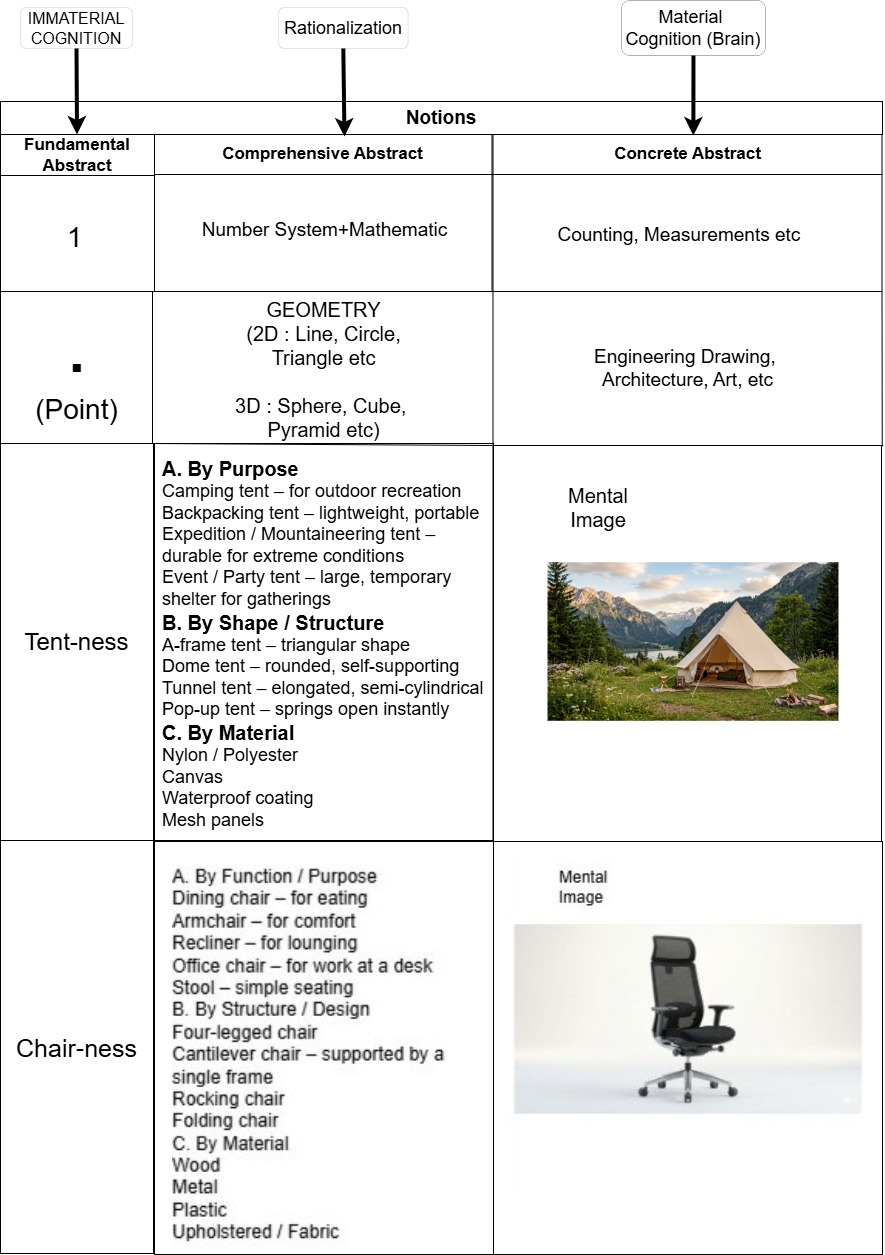
Fundamental Abstract Notions
Fundamental abstract notions are the most basic ideas the mind can grasp, such as “one,” a point, gravity, chair-ness, or tent-ness. They are not physical things, but they make understanding of physical reality possible.
For example, we never perceive “chair-ness” itself—we only encounter individual chairs—but the mind recognizes what makes them belong to the same kind. Similarly, a point has no size, and gravity is not directly seen, yet both are understood through their meaning and effects.
These notions are grasped through immaterial cognition. The senses provide images and experiences, but the mind goes beyond them to understand universal meanings that are not tied to any single object.
This is why the same concept can be recognized across different situations and applied in thinking, science, and everyday reasoning.
Fundamental abstract notions therefore show that human knowing is not limited to the material world, but extends to an immaterial level of understanding.
Comprehensive Abstract Notions
Comprehensive abstract notions are higher-level ideas formed by organizing and developing fundamental abstract notions. While fundamental notions are grasped directly, comprehensive abstract notions are built through a process of rationalization—where the mind arranges, compares, and extends these basic ideas into structured systems.
Examples:
- From the notion of “one” → development of numbers and mathematics
- From the notion of a point → development of geometry (2D and 3D shapes)
- From the notion of gravity → formulation of laws describing physical behavior
This process shows the active role of the mind in thinking. It does not merely receive ideas, but actively works on them—forming connections, systems, and principles that go far beyond immediate experience.
These comprehensive abstract notions remain immaterial—they are not physical objects—but they enable precise and organized understanding of the physical world.
Through rationalization, the mind transforms simple abstract insights into complete frameworks used in fields like mathematics, geometry, and scientific reasoning.
Concrete-Abstract Notions
Applications of fundamental and comprehensive abstract concepts expressed through concrete (external, internal, or combined) representations and operations, by which these concepts are used in practice.
External representations include physical and technological media (e.g., drawings, electronics, AI systems).
Internal representations include mental imagination.
Combined representations: Operating through interaction between human cognition and external representations. Two types: Assistive Combination & Iterative Combination
1. Assistive Combination (Aiding Imagination)
External representations such as CAD or simulators support or enhance internal imagination.
You already have an idea, and external tools help you see it better or more clearly.
Examples (in Engineering):
- Looking at a CAD model to better visualize a mechanism
- Using a simulation to see motion you already conceived
- Referring to a diagram while imagining modifications
Direction: External → Internal
2. Iterative Combination (Looping for Rationalization) Not Needed
External such as simulator and internal such as mental imagination representations interact in a loop to refine understanding.
You don’t fully know the solution initially, so you go back and forth:
think → draw (CAD) → simulate & analyze → rethink → modify
This process drives rationalization.
Examples:
- Designing via trial sketches
- Running simulations → interpreting → adjusting models
- Iterative problem-solving using mathematical and visual tools
Direction: Internal ↔ External (loop)