Introduction Here
1.The Soul(form) unifies the body(matter) into one living being, giving it its essential unity.
1.a The human soul possesses the faculty of intellect and will
Note: Rational Power : Intellect and Will.| Intellect | Knowing | Truth |
| Will | Loving | Good |
2. The table above illustrates the two fundamental powers of the human soul: intellect and will. The intellect is responsible for knowing and is oriented toward truth, while the will is responsible for loving and is oriented toward good. Together, they enable a person to understand reality and freely choose how to respond to it.
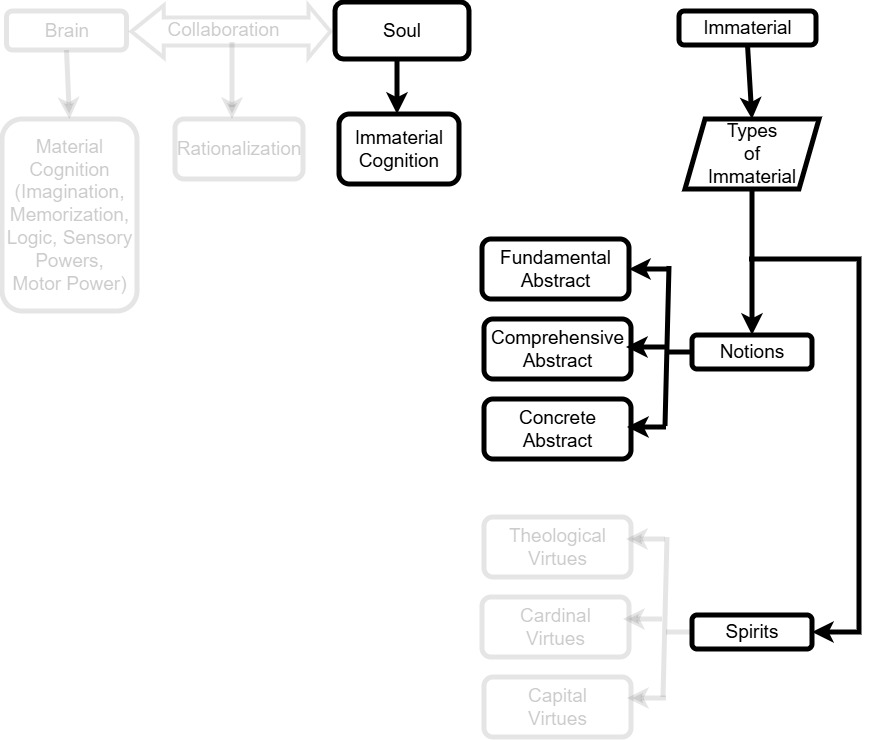
3. The diagram below illustrates the function or the ability of the soul, its interaction with the body especially the brain, and the immaterial. Let's reconstruct the entire diagram step by step and understand each part as we go. 3.The diagram below shows interaction between Soul(Form) and Immaterial. The brain(Matter) can't interact with immaterial because Matter cannot interact or develop immaterial. The soul is immaterial and so it can interact and develop immaterial. But, Soul uses the body and specifically the brain to interact and generate with the immaterial form associated to external nature.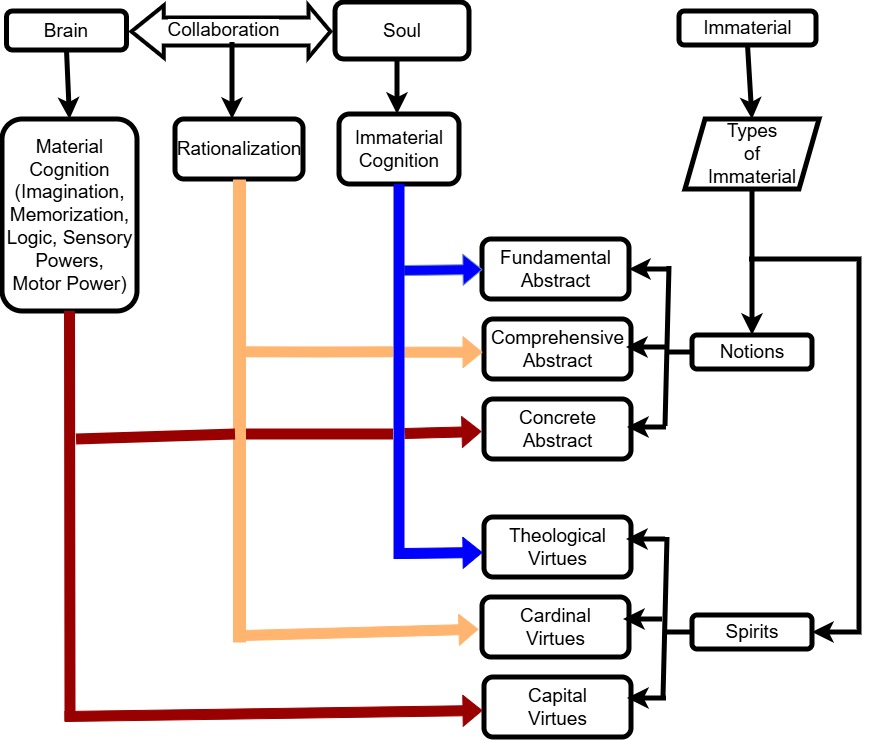
While I use the word ‘interact’, I do not mean that the soul and body are two separate objects. Rather, it is not an interaction between two things, but one unified being acting through two principles—form and matter.
4. The soul is immaterial, meaning it exists beyond the physical world, and immortal, meaning it exists beyond time itself.
5. According to Saint Thomas, the soul is like a spirit but not the same, because only the soul has the ability of immaterial cognition, a function the spirit cannot perform.
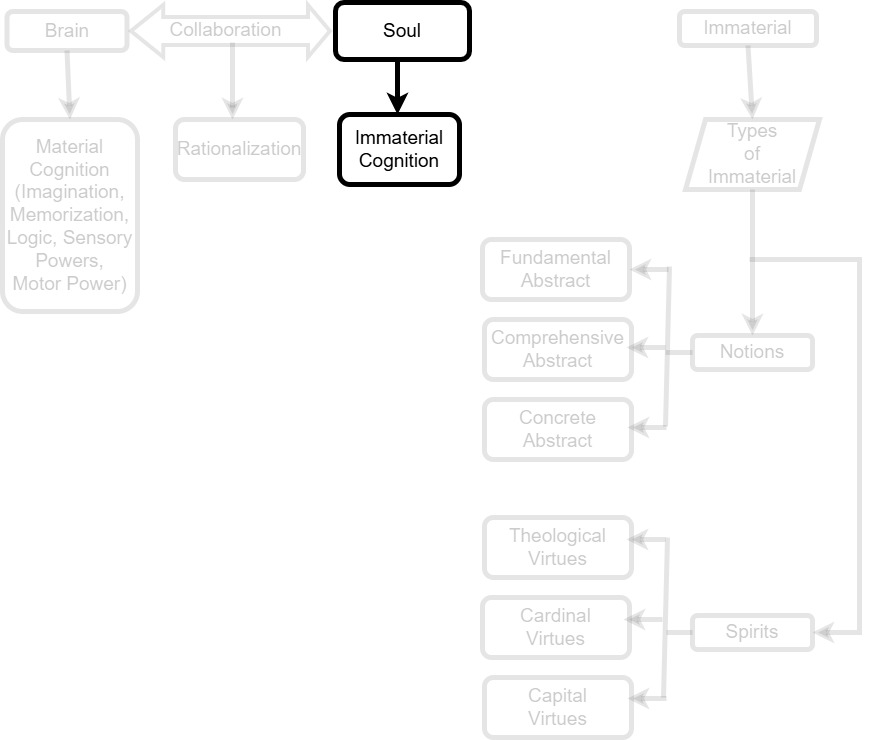
6. Immaterial cognition is the broader process by which the intellect acquires and grasps non-physical or immaterial realities, within which the intellect operates through understanding, judgment, and reasoning/thinking.
Draw a diagram of immaterial cognition and the three processes that is understanding, judgment and reasoning/thinking.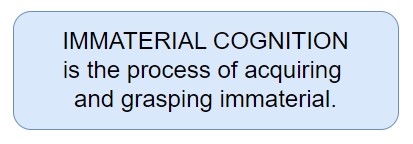
To understand this, let’s first look at the word ‘immaterial’ and what it means.
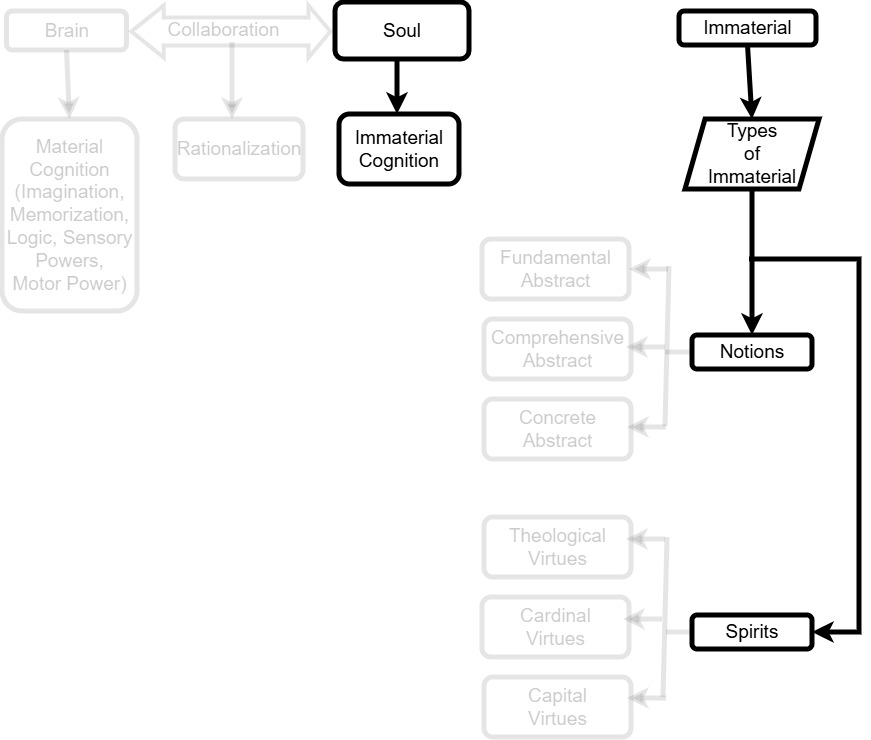
7. Immaterial means non physical or intangible material, that is, they are not made of physical matter and they’re not energy or any form of energy either.
8. Immaterial basically are of two types that is notions and spirits.
First let’s take a look at notions.
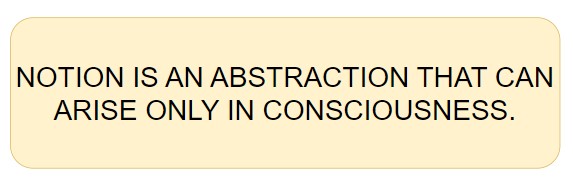
9. “A notion is an abstraction that can arise only in consciousness” Notion is an act of the intellect(soul) using the body, but not produced by any body part as such.
senses + brain provides images(phantasm) which the intellect abstracts from and forms a notion. A notion is not a feeling or emotion; it belongs to the intellect, not the senses.
 Let’s explore what that means through some simple, relatable examples.
10.A Take the number 1 in the image below....
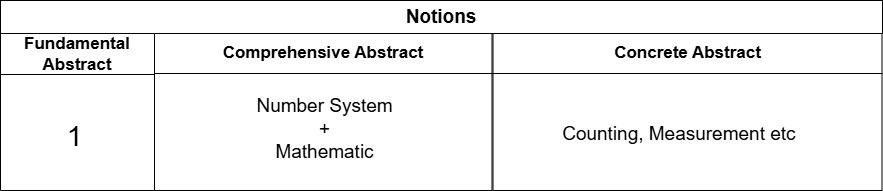
10.A.i
The number 1 is what we call a fundamental abstract notion. It’s not just a quantity it’s a foundational idea.10.A.ii
Now, once we understand ‘1’, we can conceptualize ‘2’, ‘3’, ‘4’, and so on, in the number system. The whole of the present day and future Number System and Mathematics are comprehensive abstract notions built upon the foundation of ‘1’.10.A.iii
Fields like accounting, measurement, and even computer logic rely on this system of numbers which then ultimately rely on the notion of "1". And when we apply these ideas, say, to manage finances, calculate dimensions, or program machines we’re seeing the concrete abstract form of these notions in action.10.B Now let’s move to geometry.
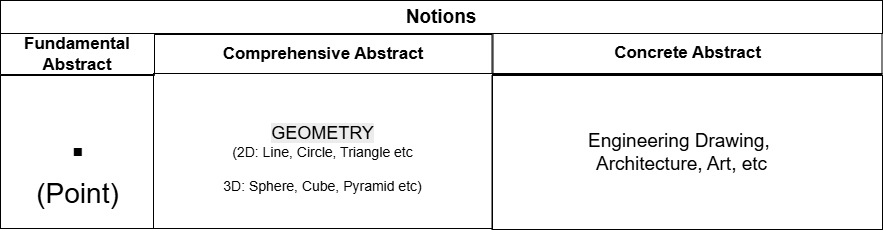
10.B.i
Here, the point is a fundamental abstract notion. It’s the most basic idea in space. It has no length, no width, no depth.10.B.ii
From that idea of a point, we build lines, circles, and complex shapes these are comprehensive abstract notions.10.B.iii
When architects draw buildings or engineers design components using CAD software, they’re taking those abstract notions and applying them. That’s where they become concrete abstract notions used in the real world to create real things.
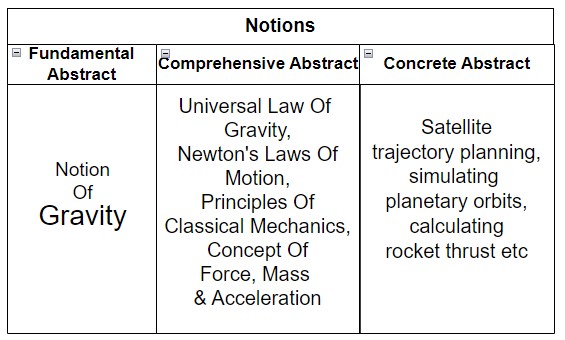
10.C Let’s take one more. This time, from physics.
10.C.i
The idea of gravity itself, the invisible force that holds us to the Earth, is a fundamental abstract notion.
10.C.ii
From it, we develop laws, equations, and models, Newton’s laws gravitation and so on. These are comprehensive abstract notions.10.C.iii
But when we use these ideas to calculate the trajectory of a satellite, or to design a rocket engine, those abstract notions take concrete form. That’s when they become concrete abstract notions, guiding real-world action and innovation.
So, to recap:A fundamental abstract notion is the seed or the core idea.
A comprehensive abstract notion is the tree, the developed framework or structure based on that seed.And a concrete abstract notion is the fruit, the real-world use, the practical application.
11. (As said earlier ) According to St. Thomas Aquinas, the soul possesses immaterial cognition, the power to understand and reason with immaterial forms, which enables higher intellectual activities such as abstract truths, concepts, and theories. In contrast, the material mind or brain carries out lower-level intellectual and cognitive functions, such as recognizing patterns and carrying out reasoning and understanding but only in a material-level way, without accessing deeper immaterial truths but enough to do basic tasks like finding food, responding to stimuli, or navigating their environment.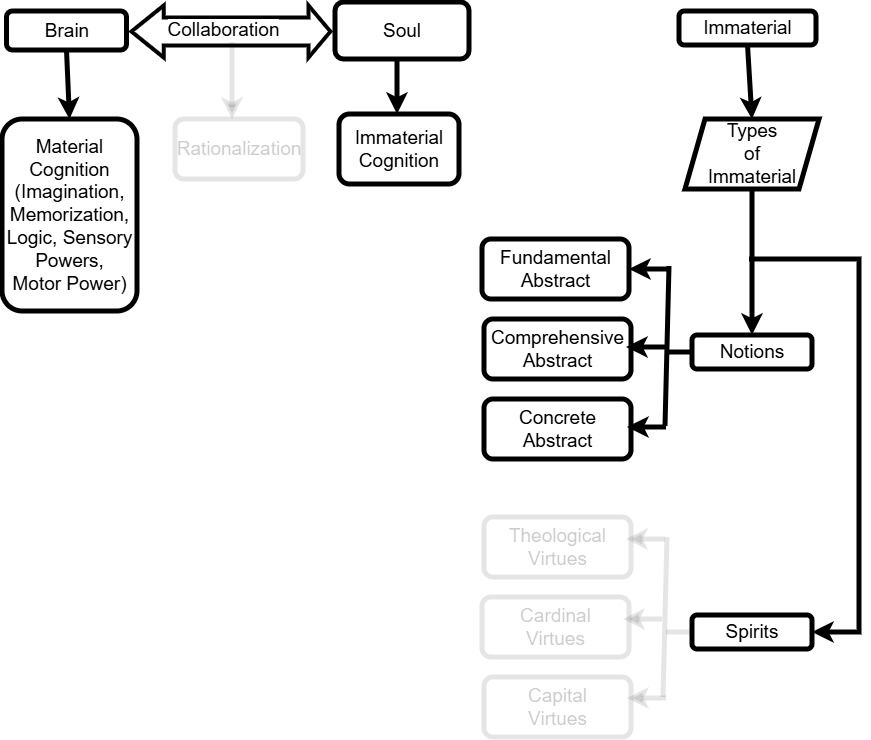 12. To understand what is the difference between higher intellect of the soul and lower intellect of the brain, let's look at the table in the image below:
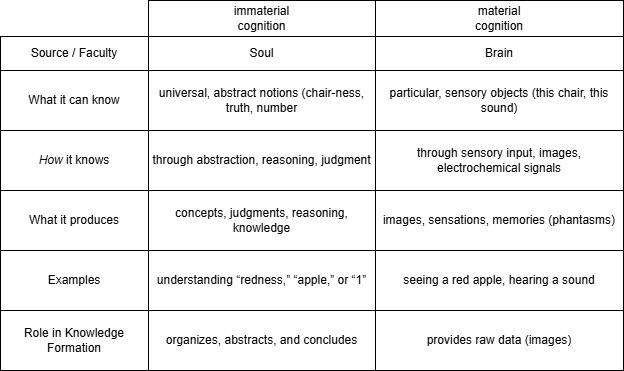
13.“The intellect (or higher intellect) of the soul uses the lower intellect — that is, the sensory and imaginative powers associated with the brain — to move step-by-step from one truth to another in a process called discursive reasoning or rationalization.”
Note: I renamed the term “Discursive Reasoning“ with “Rationalization” because when making images one word is more effective than two words for clarity of understanding the image.
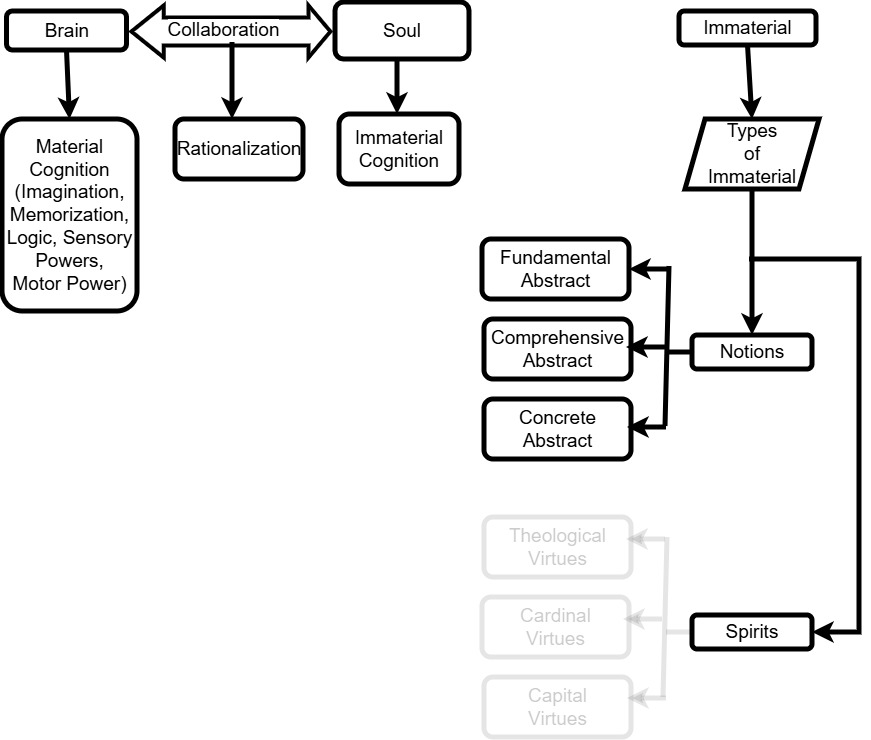
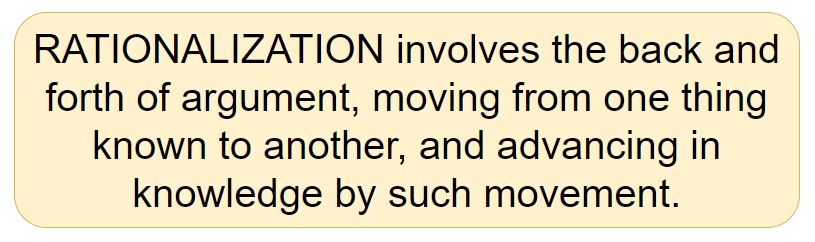
14. Definition of Discursive Reasoning (or Rationalisation): Rationalization involves the back-and-forth movement of the intellect in argument, progressing from one known truth to another and advancing in knowledge through such ordered steps.
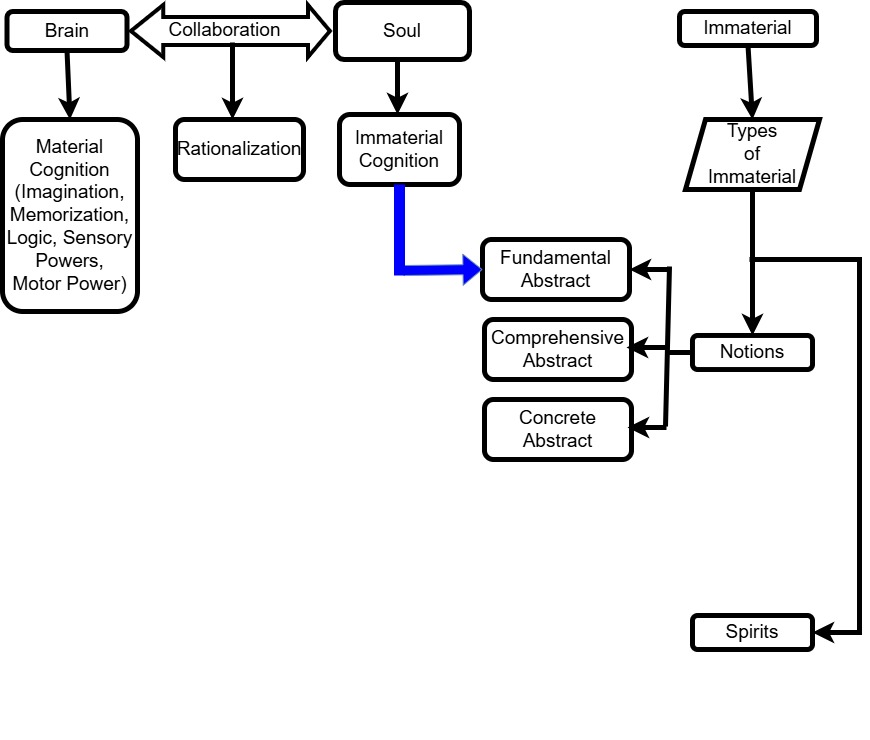
 15. The soul's immaterial cognitive power allows it to grasp, what I call, “fundamental abstract concepts” or universal and immaterial ideas that form the basis of our understanding.
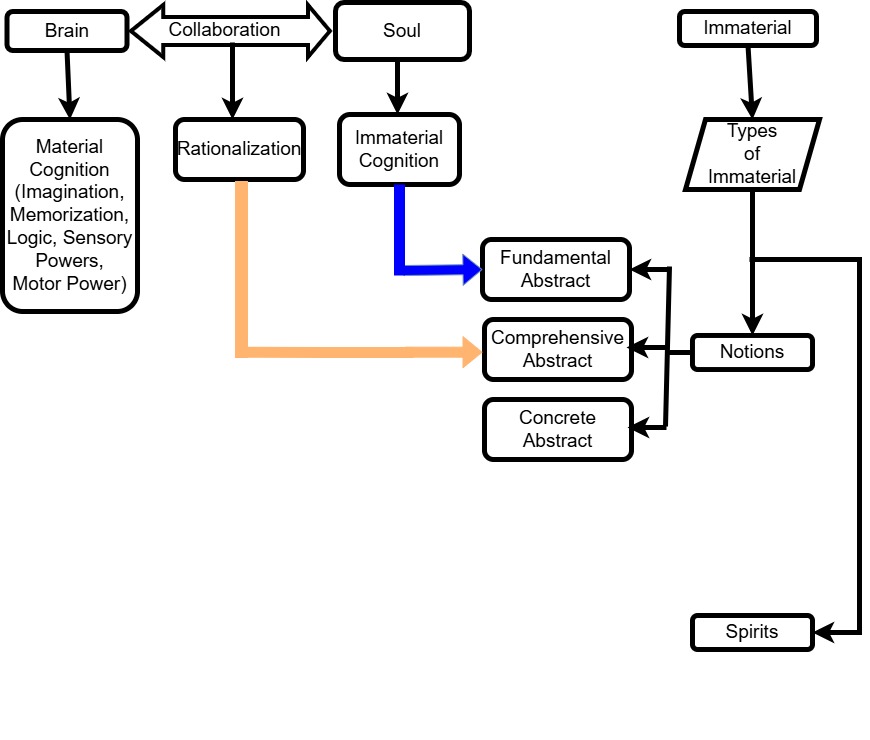
16. The soul using the brain executes the process called discursive reasoning or rationalization because of which fundamental abstract concepts are further developed into what I refer to as “comprehensive abstract concepts” that are more detailed and structured forms of thought.
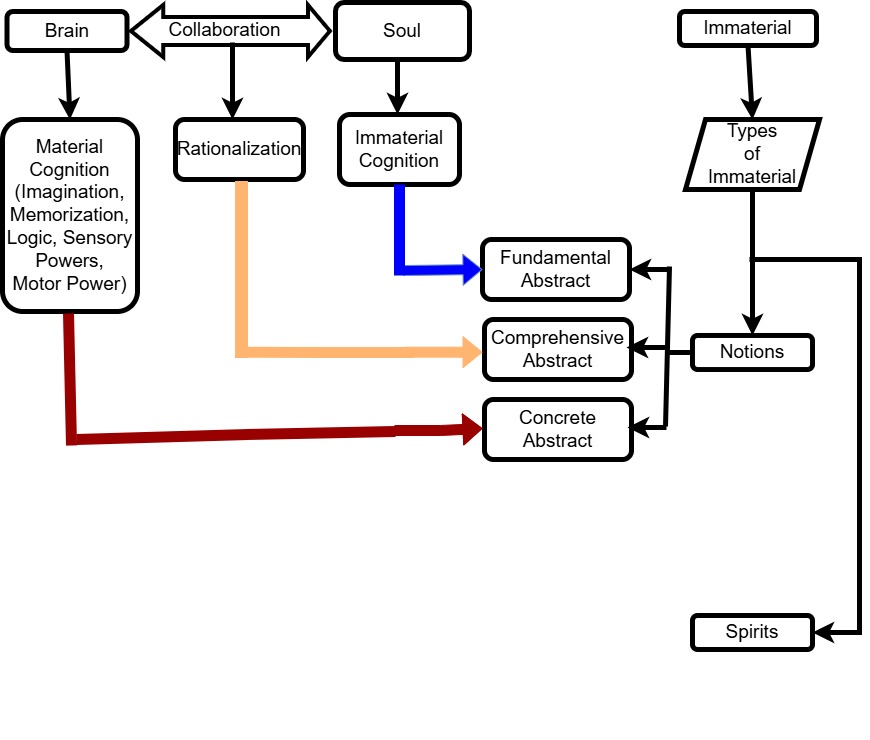
 17. Finally, the material brain contributes by forming real-world concrete–abstract representations (phantasms)—where “concrete–abstract” means concrete in origin (derived from sensory experience of particular things in the real world) yet functionally ordered toward abstraction, since they serve as the material basis from which the intellect abstracts fundamental (universal) and comprehensive abstract notions—through biological functions such as memory, imagination, and sensory processing. These phantasms serve as the necessary starting point for intellectual understanding.
18.A.i If we look back at the image below, of the mathematical example of notion that was used earlier. The number “One” on the left of the table is the fundamental abstract notion, formed by the soul.
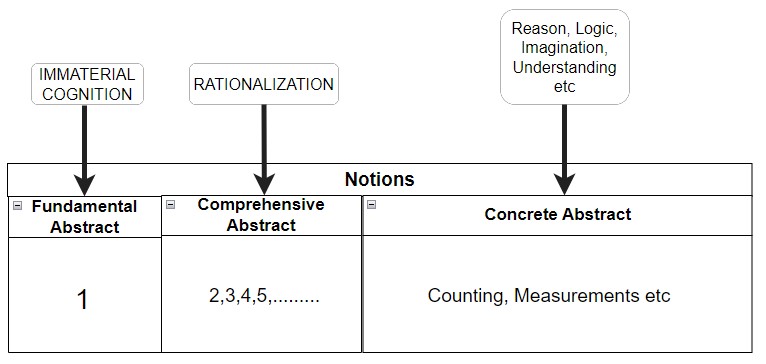 18.A.ii All other numbers of the number systems and mathematics are comprehensive abstract notions of “One” that emerge through the process of rationalization.
18.A.iii And finally, the concrete abstract applications of fundamental abstract notion “One” and comprehensive abstract notions of “Number System and Mathematics“ notions, such as counting, accounting, and so on, come from the brain related functions like all material based logic, reasoning, imagination, and memory.
18.A.ii All other numbers of the number systems and mathematics are comprehensive abstract notions of “One” that emerge through the process of rationalization.
18.A.iii And finally, the concrete abstract applications of fundamental abstract notion “One” and comprehensive abstract notions of “Number System and Mathematics“ notions, such as counting, accounting, and so on, come from the brain related functions like all material based logic, reasoning, imagination, and memory.
Let’s try to understand what the soul actually does by asking a simple question: What would happen if the human body had no soul? What is it that the body simply can’t do anymore?
To explore this, let’s look at animals. They don’t have a soul in the same sense we do, so what is it that they can’t do, precisely because they don’t have one?
Later on, I’ll talk about artificial intelligence. Just like animals, it doesn’t have a soul. But while animals have a brain, AI has something similar, a processor chip. It can do many impressive things, but there are also important things it simply can’t do, because it doesn’t have a soul. But first19. We now move to the “spirit” side of the immaterial. The spirit I am referring to is not angels, although angels are purely spiritual beings. The spirit I am referring to is the human spirit, which is the core essence of a person’s character.
“The spirit may be understood as the enduring moral orientation of the will toward what it loves, formed through repeated free choices and stabilized into dispositions toward truth or falsehood, and toward love of self or love of others. It is not a separate spiritual being, nor is it stored in the brain, but exists at the level of the will itself. It is therefore intentional, moral, and interior in nature, rather than a body-level habit driven by instinct, conditioning, or muscle memory, which are mechanical in character.”
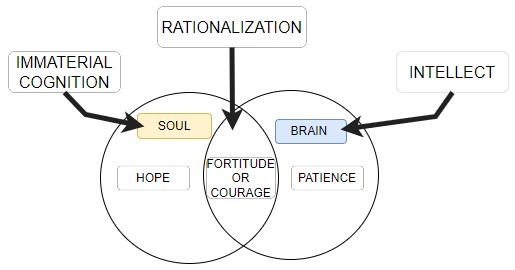
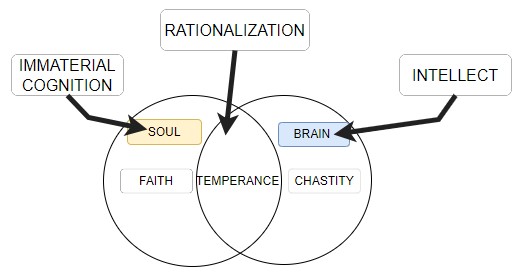
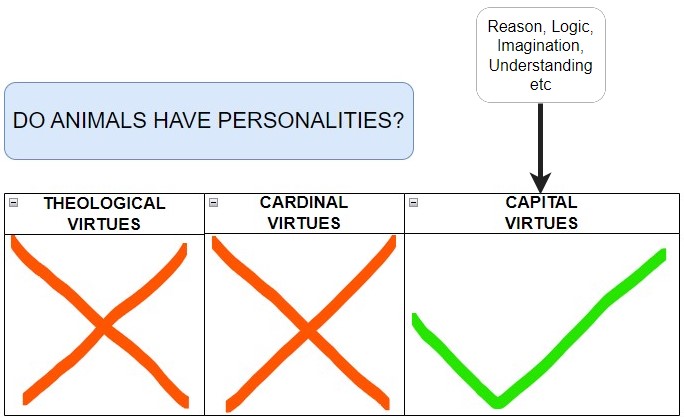
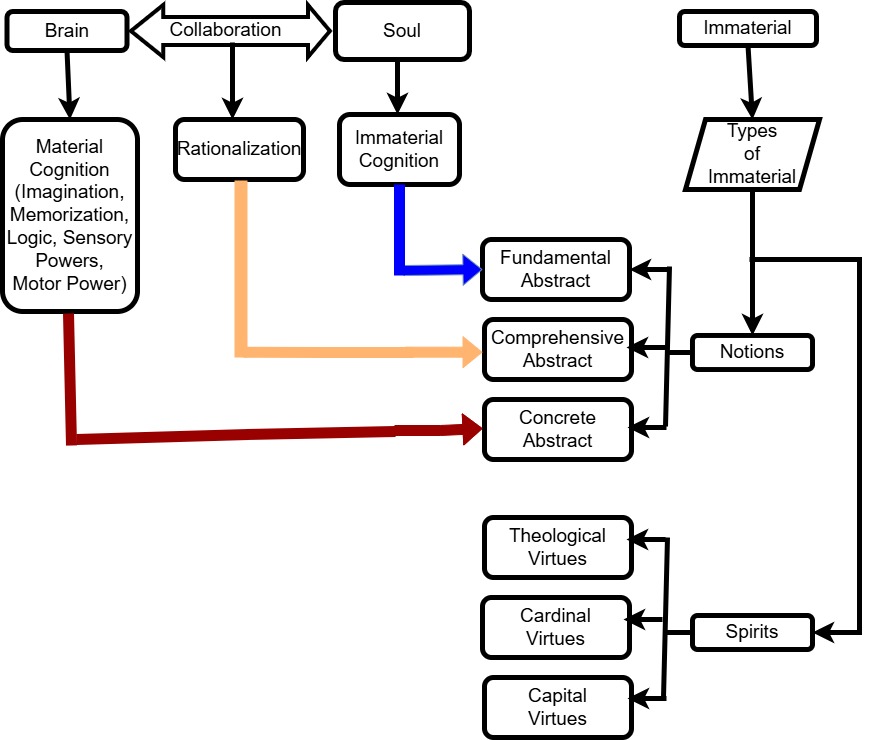 20. The Spirit or the core essence of a person’s character are of 3 types: that is the Theological Virtues, Cardinal Virtues and the Capital Virtues.
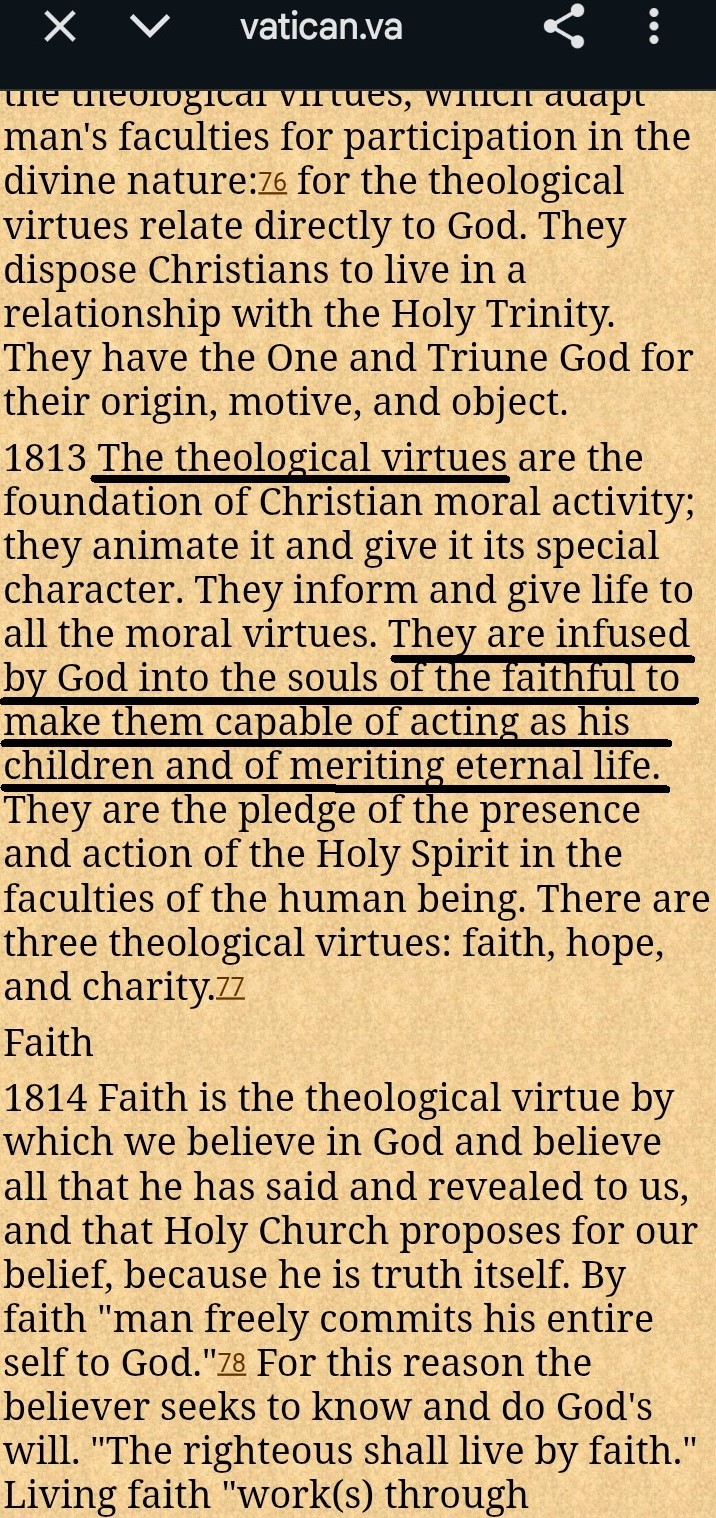
21. According to Catholic theology, the theological virtues are infused directly by God into the soul, a process made possible because of the soul’s immaterial cognition power to understand universal truths.
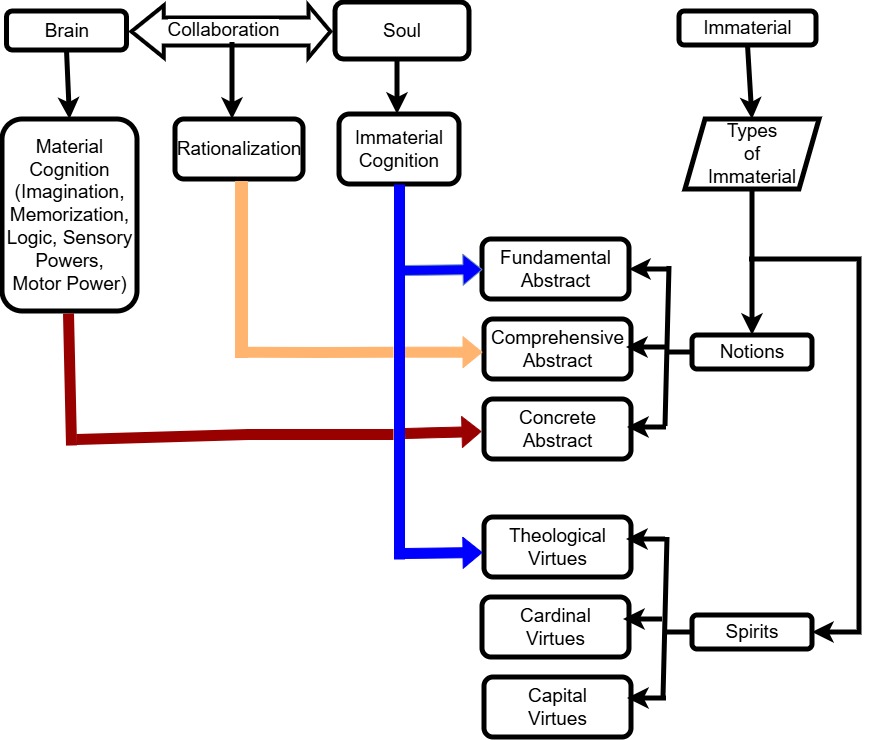
22. In contrast, the cardinal virtues are developed and strengthened through rationalization.
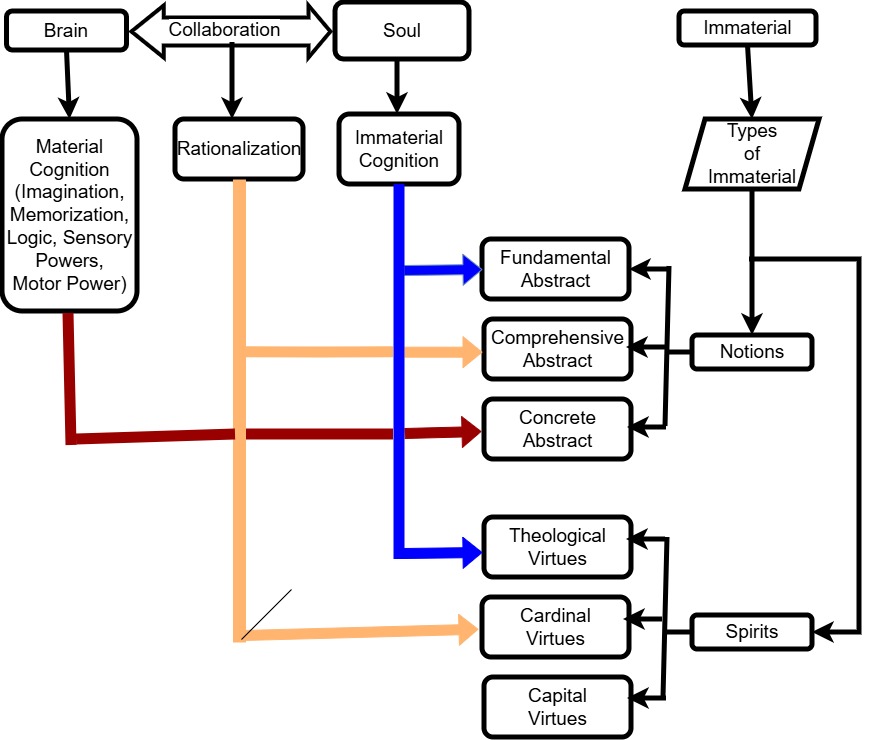 23. The capital virtues represent practical and observable behaviour or character of a person. The Capital Virtues are shaped by logic, reasoning, imagination, memory, and other abilities of the brain.
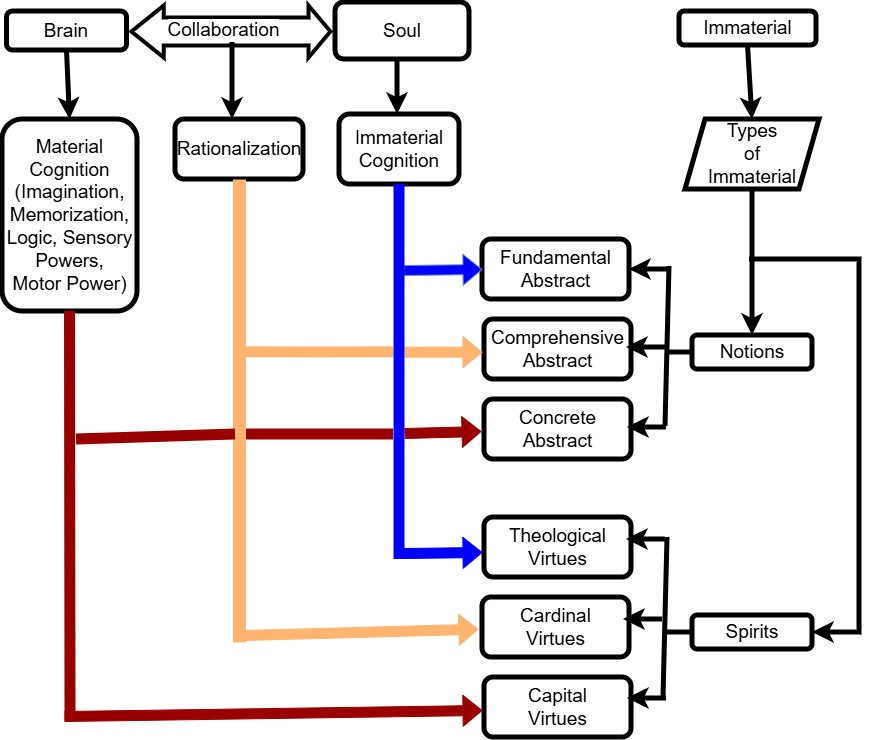 This diagram below is a visual representation
24. Example:
24.A.i
For instance, the cardinal virtue of Prudence, in the image below, does not arise spontaneously or in isolation; it is cultivated through the interplay of theological virtue of love and tempered by the capital virtue of humility, provides the moral and emotional grounding from which Prudence is rationally formed.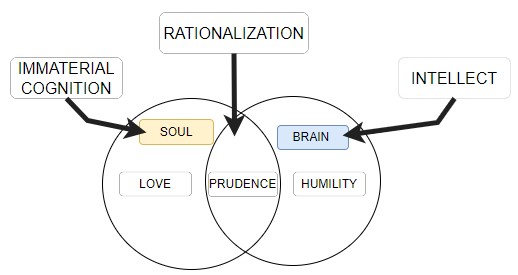
24.A.ii
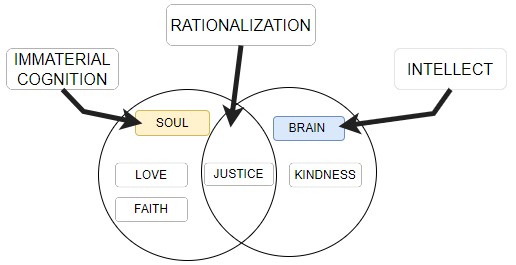
Justice, the habit of giving each their due, is rationalized through love and faith, which teaches us the inherent dignity of every person, and the capital virtue of kindness, which curbs the capital vice of envy. This combination rationalizes Justice or moral clarity required to treat others fairly.
24.A.iii
Fortitude, or courage, does not arise simply from brute strength, but through the rational alignment of the theological virtue of hope with the capital virtue of patience. Hope offers the vision of a good worth enduring hardship for, and patience sustains effort in the face of fear and difficulty.
24.A.iiii
Temperance is shaped through the rational interaction of self-control (opposing gluttony and lust) with the theological virtue of faithfulness, which anchors desires in higher purpose rather than fleeting pleasure.
What about animals? Their brains can be quite advanced, but without a soul, what does that mean for their relationship to things like virtue, morality, or even love?
Vices are the opposite of virtues. Since there are spiritual virtues, you might be wondering, are there spiritual vices too?”
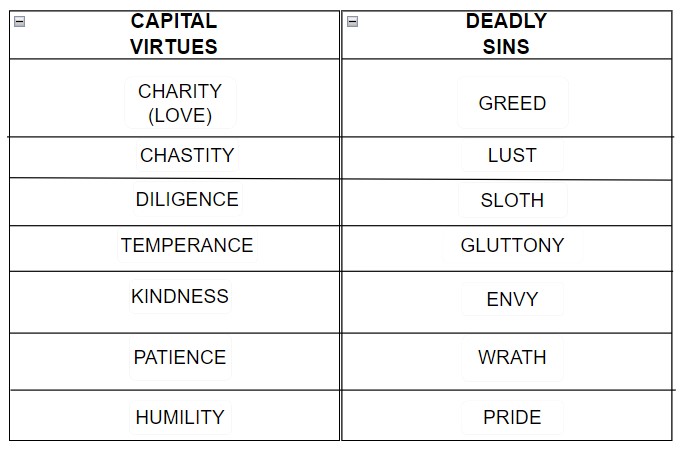 25. Vices are not spirits. To understand why, consider this analogy: vices are like holes in a shoe or a piece of cloth.
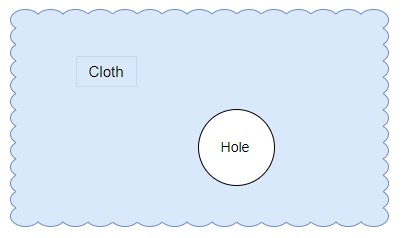 26. Does the hole exist on its own? Can you cut it out and show it as a separate object? No.
27. A hole only exists because the material around it exists. The hole is simply the absence of something that should be there, it’s not part of the original design.
28. In the same way, vices are not created things, they’re like holes in the soul or spirit, representing the absence of virtue. Unlike virtues, which are real and positive qualities, vices are distortions or lacks. They are not spirits.
26. Does the hole exist on its own? Can you cut it out and show it as a separate object? No.
27. A hole only exists because the material around it exists. The hole is simply the absence of something that should be there, it’s not part of the original design.
28. In the same way, vices are not created things, they’re like holes in the soul or spirit, representing the absence of virtue. Unlike virtues, which are real and positive qualities, vices are distortions or lacks. They are not spirits.
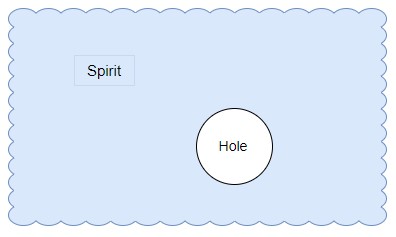
29. Vices are the holes in the spirit.
Note 1:
According to St. Thomas Aquinas, when we engage in activities like abstract thinking, rational reflection, and intellectual insight, we’re not doing three separate things.We’re actually performing one unified act: the act of knowing.”
But animals and AI cannot know in the way humans can. Because knowing, as Aquinas would say, is about the soul encountering truth.And animals and ai don’t have a soul.
Note 2:
St. Thomas Aquinas distinguished between two levels of intellect:1. The
higher intellect
, rooted in the immaterial soul, is capable of grasping abstract and universal truths, what he considered true understanding. The lower intellect refers to the material aspect of human cognition, which operates through the senses, logic, thinking, imagination, and memory.2. This