Intellect
The intellect is a power of the soul through which a human being knows, understands, and reasons. It operates through immaterial cognition (knowing abstract truths) and rationalization (reasoning from one truth to another), while depending on material cognition (the brain’s sensory and image-based processes) for data.
As seen in the diagram below, the higher intellect of the soul performs reasoning and cognition at an immaterial level, whereas the intellect of the brain (the lower intellect) carries out reasoning and logic at the material level.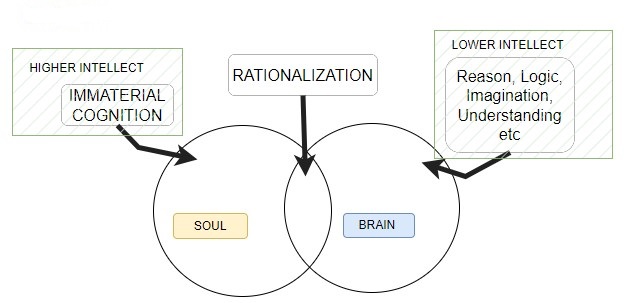
Immaterial Cognition
This is source of intellect’s power to know universals, abstract truths, and immaterial realities.
Immaterial cognition consists of reasoning and understanding the immaterial aspects of material form, and it reduces material reality to its simplest principles: unity in quantity and point in space, neither of which exists materially, yet both are necessary for understanding number and shape.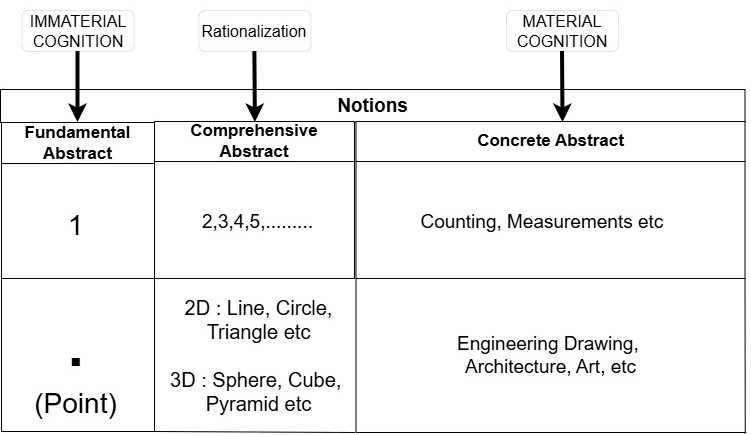
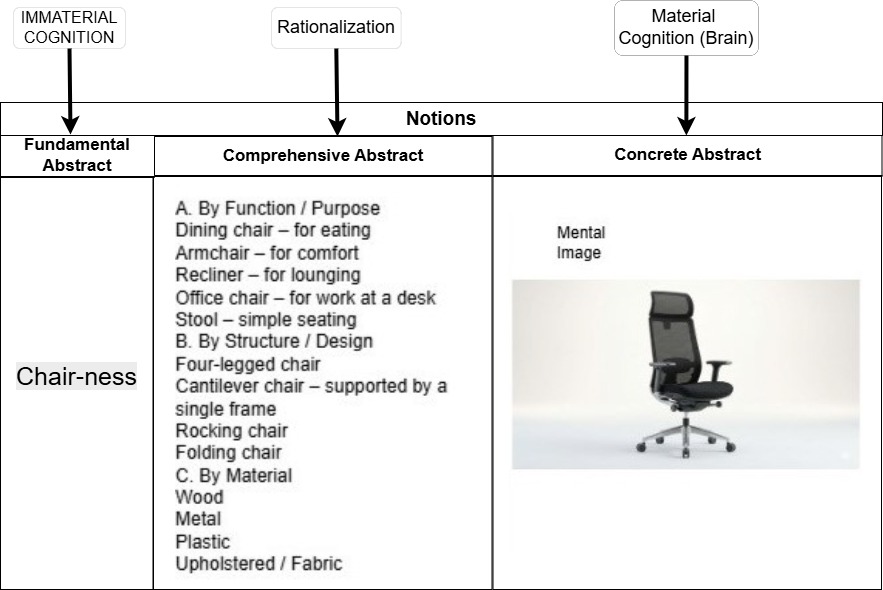
In immaterial cognition, the intellect grasps chair-ness as a fundamental abstract, the simplest principle by which any object is recognized as something meant for sitting. When we think of a specific instance, such as an office chair, the mind forms a mental image, which is a concrete abstract derived from imagination or from experience and accessed through memory. From this, rationalization develops comprehensive abstraction by organizing chairs according to function (dining, recliner, office), structure (four-legged, cantilever, rocking, folding), and material (wood, metal, plastic, upholstered), while also generating new designs through imagination that aim to realize chair-ness in specific and practical forms.
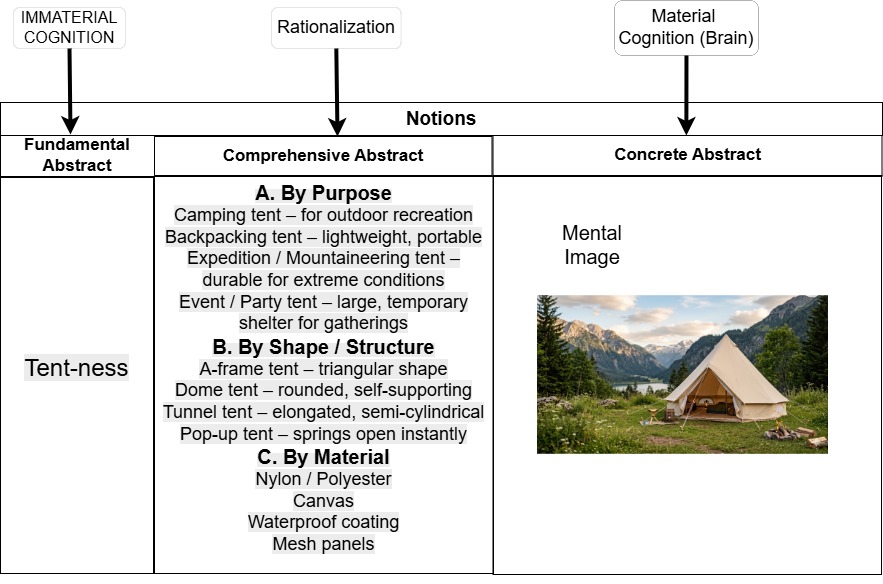
Similarly, in immaterial cognition, the intellect grasps tent-ness as a fundamental abstract, the simplest principle by which any structure is recognized as a temporary shelter. When we think of a specific instance, the mind forms a mental image, which is a concrete abstract derived from memory or imagination. From this, rationalization develops comprehensive abstraction by organizing tents according to function, structure, and material, and also rationalization generates new designs through imagination, each aiming to realize tent-ness in specific and practical forms.
 In simple words: Immaterial cognition is thinking, understanding, and reasoning about things that are not physical, like ideas, meanings, truth, and general concepts.
Rationalization
An act of the intellect (of the soul not of the brain), where it reasons from one truth to another, using images provided by the brain.
Through rationalization (discursive reasoning), the soul’s intellect forms comprehensive abstract notions by relating fundamental abstract notions.Rationalization develops mathematics and geometry from fundamental abstract notions such as “1” and “point,” respectively.
This means that once the soul’s intellect has grasped basic universal ideas—such as one, point, it can actively relate them to one another to build richer and more detailed concepts. For example, from the fundamental abstract notion of one, the soul’s intellect forms 2, 3, 4, .... by understanding repeated oneness, and from these arise arithmetic operations such as addition, subtraction, multiplication, and division, which are comprehensive abstract notions expressing relations between numbers rather than mere collections of objects. Similarly, from the fundamental abstract notion of a point, which has no size or shape, the soul’s intellect forms lines by understanding ordered points, two-dimensional shapes such as squares and circles by relating lines, and three-dimensional shapes such as cubes and spheres by relating surfaces. These are not directly given by the senses, but are intelligible structures formed by reason.Examples
More day to day examples:
Chairs: Organized by function (dining, recliner, office), structure (four-legged, cantilever, rocking, folding), and material (wood, metal, plastic, upholstered), while also generating new designs that aim to realize “chair-ness” in practical forms.
Tents: Organized by function, structure, and material, while also generating new designs that aim to realize “tent-ness” in specific and practical forms.
In simple words: Rationalization is thinking, understanding, and reasoning using both physical images (from the brain) and non-physical meanings (by the intellect).
Material Cognition
Material cognition is the level where the soul operates through the brain and body, using sensory input and neural processing. Mechanically, this begins with the senses taking in data—sight, sound, touch—after which the brain converts these into electrical and chemical signals. These signals are processed into images, memories, and associations. The mind at this level does not “know” in the immaterial sense. The mechanics are: input (senses) → encoding (neural signals) → storage (memory) → recall and association → response (emotion, impulse, or action tendency). This is why this level is called material cognition—it depends on physical structures and processes, even though the soul uses them as instruments.
The brain’s sensory operations: perception, imagination, memory, and image-processing.
The (lower) cognitive or sensory-cognitive function of the brain carries out material operations such as imagination, memory, phantasia, sensory recognition, association, and image-based processing.
Key Operations
- Imagination (phantasia) — forming and manipulating internal images.
- Memory (memorativa) — retaining and recalling sensory images.
- Phantasia — refining, combining, and recombining images.
- Sensory Recognition — identifying what an image represents.
- Association — linking images, patterns, and experiences.
- Cogitative Power (particular reason) — making instinctive judgments about particulars.
- Discursive Image-Based Processing — step-by-step processing that depends on images.
These operations are material, sensory-based forms of “thinking,” but they are not true intellectual reasoning.
The brain performs lower-level logical processing—such as pattern comparison, association, and sensory-based inference. However, true logical reasoning, which operates on universals and abstract concepts, belongs exclusively to the soul’s immaterial intellect.
Note: Imagination vs Phantasia
Imagination is a single internal sense power that produces and manipulates images.
Phantasia refers to the broader sensory-image system—formed by imagination, memory, recognition, and association—from which the intellect abstracts universal knowledge.
In simple words: Material cognition is thinking, understanding, and processing things that are physical, like images, sounds, memories, and sensory experiences.
Clarification on Soul and Brain (St. Thomas Aquinas)
St. Aquinas strictly rejects the idea of a combination in the following sense:
- Brain + Soul
- Material + Immaterial
The diagram may suggest this at first glance, but that is not the intended meaning.
Rather, the diagram expresses that the soul cooperates with the brain. The soul uses the brain to obtain sensory data, without which it cannot exercise its intellectual powers of thinking and reasoning.
Without the soul, the brain can:
- Store memories
- Process images
- Compare patterns
- Control signals
- Coordinate the body
However, it cannot understand:
- Universals
- Abstract essences
- Meaning
- Truth
- Laws
- Non-physical concepts
Without the soul, the brain functions like an empty computer—able to process signals, but incapable of intellect, understanding, or rational thought.
The Operation of the Soul
The operation of the soul through the intellect is “knowing”, which consists of:
- Understanding truth
- Judging truth
- Reasoning from one truth to another
How the Soul and Brain Cooperate
The cooperation happens in the following order:
-
Senses receive data
- Eyes, ears, touch, etc.
- Images, memories, sensory maps
(ST I, q.84)
-
Brain forms phantasms
Aquinas teaches that the intellect cannot think without phantasms (mental images).
- Sensory memories
- Images
- Imagination
- Emotional coloring
- Pattern recognition
- Attention and coordination
(ST I, q.84, a.7)
-
Intellect abstracts a universal idea
Immaterial Cognition: The intellect can know:
- Universals (humanity, triangularity, justice)
- Example: From many circles, it understands “circularity”
- Immaterial realities (truth, laws, mathematics)
- Meanings, not just sensory shapes
This is called immaterial cognition because:
- It is not limited by physical matter
- Its objects are not material
- It understands abstract form
(ST I, q.85, a.1)
-
Intellect forms judgments
“This is true” / “This is false”
-
Rationalization (Reasoning)
Argument, conclusion, decision.
Rationalization = the intellect performing higher operations:
- Simple apprehension – forming a concept
- Judgment – determining truth or falsehood
- Reasoning – moving from premises to conclusion
(ST I, q.85, a.2–3)
→ Rationalization is an immaterial act of the intellect.
→ It does not belong to the brain, but uses the brain’s data.
Conclusion
Thus:
- The brain supplies the matter
- The intellect supplies the form